

Unit plan template and a Year 10 History example
A unit plan brings lessons together around a clear learning goal. It shows what students will learn, how they will practise and what work will show their learning. This page gives you a blank template and a real Year 10 History example made in TeaCheese Lite. You can open the assessment, marking guide, unit and two lessons to see how they connect.
Free unit plan template
Choose Word to edit or PDF to read and print. No account or email is needed.
A real Year 10 History example
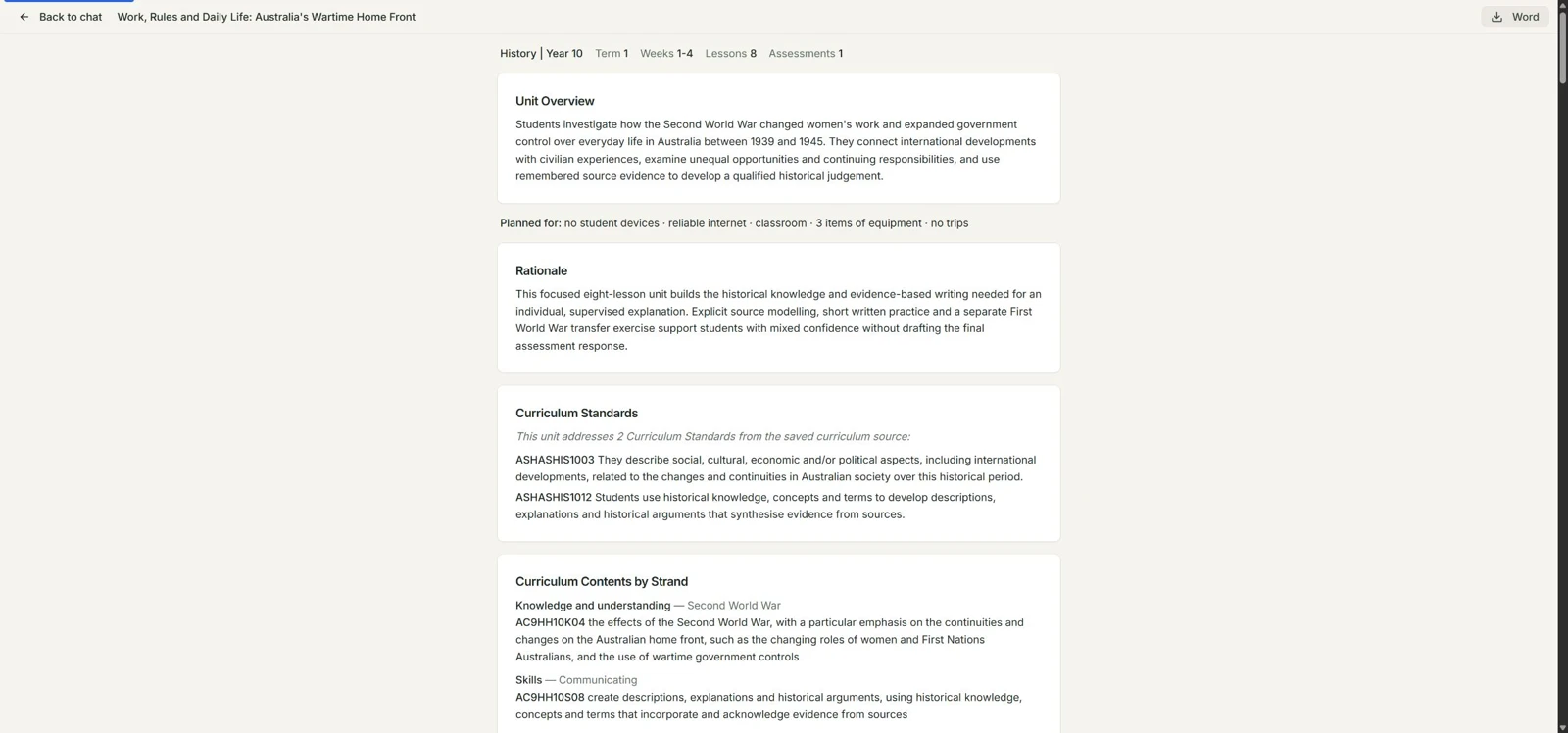
We created this example in TeaCheese Lite on 20 October 2026. The topic is World War II and the Australian home front. Students explore women’s wartime work and government controls on everyday life between 1939 and 1945. The files below are the original application exports. Their wording has not been rewritten for this article.
| Part | Our example |
|---|---|
| Learning area | Year 10 History, Australian Curriculum v9. |
| Length | Four weeks, with two 50 minute lessons each week. |
| Main idea | Explain what changed and what continued in everyday life on the Australian home front. |
| Classroom | Printed historical sources, paper, a board, a teacher laptop and a projector. No student devices or trips. |
| Final task | An individual historical explanation of 400 to 500 words, completed in 50 minutes in Week 4. |
| Connected resources | One assessment, its marking guide, a unit with eight planned lessons and two selected lesson examples. |
Download the History examples
Open the original Word files to explore and edit. No account or email is needed. The marking guide is included in the assessment copies.
History unit plan
Four weeks with a final World War II task in Week 4. First World War practice appears earlier. Add your own detail to the shorter lesson descriptions.
Student assessment and marking guide
A World War II explanation with three sections, 400 to 500 words and 50 supervised minutes. Includes the A to E guide.
Teacher copy and marking guide
The original teacher copy includes the marking guide, 4Cs notes, curriculum links and model responses.
Lesson example on comparing sources
Lesson 2 names a photograph, employment table and recruitment poster. Prepare the actual sources and a worked example that uses two of them.
Lesson example on using feedback
Lesson 7 reviews earlier First World War writing, then revisits World War II knowledge. Prepare the passages, retrieval questions and answers.
Start with the learning
This example selects two sentences from the Year 10 History achievement standard. One focuses on aspects of Australian society, international developments, change and continuity. The other focuses on using historical knowledge and source evidence in explanations and arguments. It does not cover the whole year of History.
The chosen content descriptions are AC9HH10K04 for the Australian home front and AC9HH10S08 for historical writing using evidence. The teacher copy lists the selected curriculum and shows which parts of the task use it.
A code helps you find the curriculum. The wording tells you what students need to learn. ACARA’s assessment guidance explains how content descriptions and achievement standards work together. Keep the official wording in your plan, then write a short learning goal your class can use.
Students need to know what successful work looks like. Here, they need to describe change and continuity, connect ideas and support an argument with evidence. AERO’s learning goals guidance explains how clear goals help students understand what they are working towards.
See how the pieces connect
- Choose the learning. The selected standard sentences and content descriptions give the task its focus.
- Set the assessment. Students explain how World War II changed everyday life on the Australian home front.
- Review the marking guide. It shows what the student work needs to demonstrate.
- Build the unit. The weekly teaching and practice lead towards that saved assessment and its Week 4 date.
- Open the lessons. Each lesson turns part of the weekly plan into teaching steps, practice and a short check.
In Lite, a unit is built around an assessment. Choose a suitable saved task or create one first. For this example, the assessment came first. The unit then used that task, its marking guide, the selected curriculum and the classroom settings.
The final task asks students to evaluate the claim that World War II transformed everyday life on the Australian home front. They write about women’s work, rationing, labour direction, change and continuity. They use evidence studied in class. There is no extra research or homework for the final task.
The unit therefore needs to teach the historical ideas and give students practice using evidence in an explanation. A lesson that only lists wartime events would not prepare students for the full task. Read the assessment and weekly plan together so you can see that connection.
Open the marking guide and 4Cs notes
The marking guide is inside both assessment downloads. It has two equally weighted criteria: Knowledge and understanding, and Skills. C keeps the selected achievement standard wording. The other bands describe differences in the evidence students show.
The teacher copy also explains the 4Cs choices used in the bands. You can see the changes beside the curriculum wording, along with the task mapping and model responses. This gives you something concrete to review before marking. Explore the marking guide builder to see the workflow.
Model responses are examples for the teacher. They are not the only acceptable answers. Use the guide with accurate evidence from the sources your class actually studied. Keep teacher responses separate from the student task when sharing files.
See the four weeks of teaching
| Week | Main focus |
|---|---|
| Week 1 | Build the historical background and practise comparing sources about women’s work. |
| Week 2 | Explore government controls, rationing and labour direction. Practise explaining connections. |
| Week 3 | Explore unequal experiences and practise organising a historical explanation. |
| Week 4 | Use feedback, check learning and complete the saved assessment. |
The unit uses a separate First World War practice task to rehearse writing before the final World War II assessment. The feedback lesson refers to that practice. This is why both wars appear in these examples. The final assessment remains about World War II.
ACARA’s sequencing guidance describes how learning builds over time. Start with clear examples, practise together, then ask students to apply what they have learned. AERO’s explicit teaching guidance explains how modelling and guided practice support this process.
Look inside two lessons
The source comparison lesson names a photograph, an employment table and a recruitment poster. Those sources are not supplied. Its saved model uses one source, so prepare a worked explanation that combines two actual sources before asking students to do that themselves.
The feedback lesson shows students revising practice writing before returning to the final topic. It includes short checks of dates, ideas and source evidence. Prepare suitable passages and clear questions with answers before the lesson. These examples retain the application’s own review notes.
A plan can tell you which resources to prepare, but naming a source does not supply the source itself. Check dates, wording, images and reading level. Give students enough time to use the evidence before asking them to recall it in the assessment.
This is one unit, not a whole term plan. Read the term planning guide to fit its four weeks alongside other learning, assessments and feedback.
Find and prepare the actual sources
The Australian War Memorial account of the WAAAF can help you check its formation in March 1941. Its rationing account explains the 1942 regulations. These are starting points for teacher preparation, not a source pack already supplied with the downloads.
Choose actual items that support the lesson questions. Record the title, creator, date and collection reference. Check permission before copying or sharing a collection image. A recruitment poster shows a message; it does not by itself show how many women joined.
Use the blank template for your class
- Write the subject, year level, curriculum source and teaching weeks.
- Add the standard sentences or outcomes and content you will teach.
- Write the learning goal and what successful work will show.
- Add each assessment, its date and conditions.
- Plan the weekly teaching and practice that prepare students for those tasks.
- Note classroom resources, support and what you will check along the way.
More than one assessment can belong in a unit. Add each task and its date, including work that runs across several weeks. This example uses one final task. For your own plan, check the full set of dates before choosing the teaching weeks.
Keep the same learning goal when planning support. A glossary, a worked paragraph or a reading scaffold may help students take part. Record the support you will use. ACARA’s advice on including all learners gives further guidance.
Check the fit for your school before teaching. Use the correct curriculum, assessment approach and classroom resources. If your school uses a state curriculum, choose its official wording. Changing a code alone is not enough. See the curriculum options before you start.
Use Lite to create downloadable resources, or explore the Planning Wizard to keep curriculum maps, marking guides, assessments, units and lessons connected. See how the unit planner connects the work.
Sources and further reading
- Aligning curriculum and assessment, Australian Curriculum. Page date not stated. Accessed 21 October 2026.
- Sequencing learning, Australian Curriculum. Page date not stated. Accessed 2 September 2026.
- Including all learners, Australian Curriculum. Page date not stated. Accessed 2 September 2026.
- Explain learning objectives, Australian Education Research Organisation. Updated 31 March 2025. Accessed 2 September 2026.
- Teach explicitly, Australian Education Research Organisation. Updated 31 March 2025. Accessed 2 September 2026.
- Women in the WAAAF, Australian War Memorial. Updated 20 November 2025. Accessed 21 October 2026.
- Rationing of food and clothing during the Second World War, Australian War Memorial. Page date not recorded in this review. Accessed 21 October 2026.